
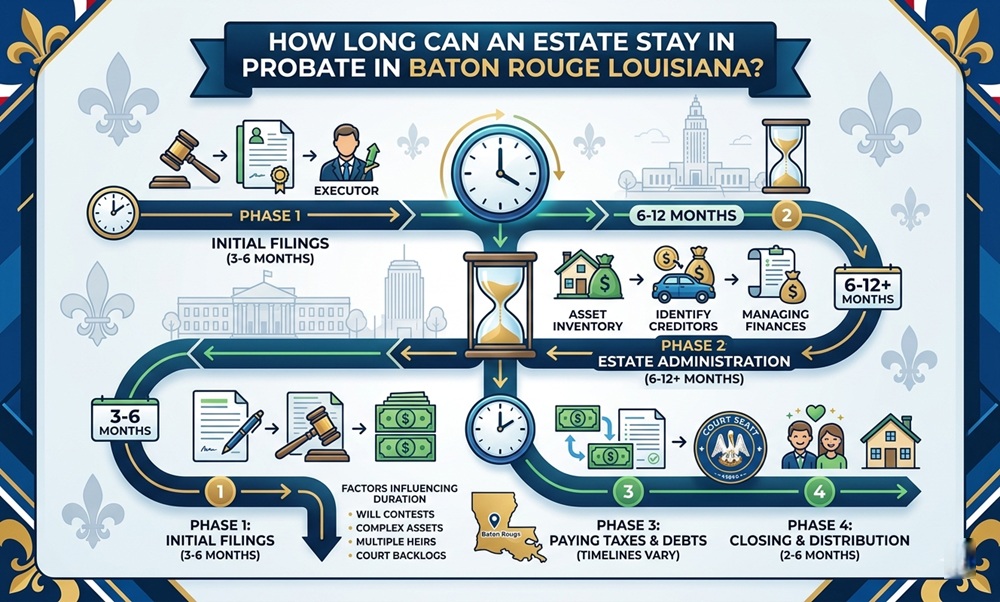
Losing a loved one is hard enough. Then comes the wait — months or sometimes years — while their estate moves through probate. If you’re dealing with a Baton Rouge estate, you should know that Louisiana uses a unique legal system that differs significantly from most states. Understanding it can help you manage expectations and avoid costly delays.
Louisiana’s Succession System vs. Traditional Probate
Louisiana doesn’t call it “probate” — it uses the term succession. This distinction matters because the state operates under civil law (derived from French and Spanish legal traditions), not common law like the other 49 states.
A Louisiana succession is handled through the 19th Judicial District Court in Baton Rouge (East Baton Rouge Parish) and involves either:
- Small succession affidavit (for estates under $125,000 with no real estate) — can be resolved in weeks
- Formal succession proceeding — required for larger or more complex estates
Typical Timelines in Baton Rouge
| Estate Type | Estimated Timeline |
|---|---|
| Small succession affidavit | 2–6 weeks |
| Uncontested formal succession | 4–12 months |
| Contested succession | 1–3 years or more |
| Complex estates (business, multiple properties) | 1–5 years |
There is no statutory maximum on how long a Louisiana succession can remain open. Theoretically, complex or disputed estates could remain in the court system indefinitely — though this is uncommon in practice.
What Causes Delays in Baton Rouge Successions?
- Will disputes — If heirs challenge the validity of a will, the proceeding stalls
- Creditor claims — Louisiana law requires a period for creditors to file claims
- Multiple properties or out-of-state assets — These require ancillary proceedings
- Forced heirship complications — Louisiana uniquely protects the inheritance rights of minor children and disabled adult children regardless of the will
- Missing heirs — Courts may require extensive searches before distributing assets
Louisiana’s Forced Heirship Rule
This is one of the most distinctive aspects of Louisiana succession law. Under Louisiana Civil Code Article 1493, children under 24 (and some disabled adult children) are “forced heirs” — meaning they’re entitled to a portion of the estate regardless of what the will says. This can significantly complicate and extend the probate process.
Pro Tips
If you’re serving as executor (called a “succession representative” in Louisiana), hire a Baton Rouge estate attorney early. Louisiana succession law has highly specific procedural requirements that differ from every other state — a misstep can add months to the process.
Common Mistakes to Avoid
- Assuming Louisiana probate works like other states (it doesn’t)
- Waiting too long to open a succession — assets can be tied up or deteriorate
- Not accounting for forced heirship when planning distributions
- Distributing assets before the succession is formally closed
FAQs
Q: Can an estate avoid probate in Louisiana? A: Yes — through living trusts, joint ownership, payable-on-death accounts, and proper beneficiary designations. Planning ahead is the best strategy.
Q: Is probate in Louisiana public record? A: Yes. Succession proceedings filed in East Baton Rouge Parish are public court records.
Q: What happens if no one opens a succession? A: Assets may remain in legal limbo. Heirs may eventually lose access to bank accounts, real estate, and other assets.
Conclusion
In Baton Rouge, how long an estate stays in probate depends heavily on its complexity, whether it’s contested, and how efficiently the succession representative works with an attorney. Small estates can close in weeks; large or disputed ones may take years. The best advice: open the succession promptly, hire a Louisiana estate attorney, and understand the state’s unique forced heirship rules before distributing anything.