
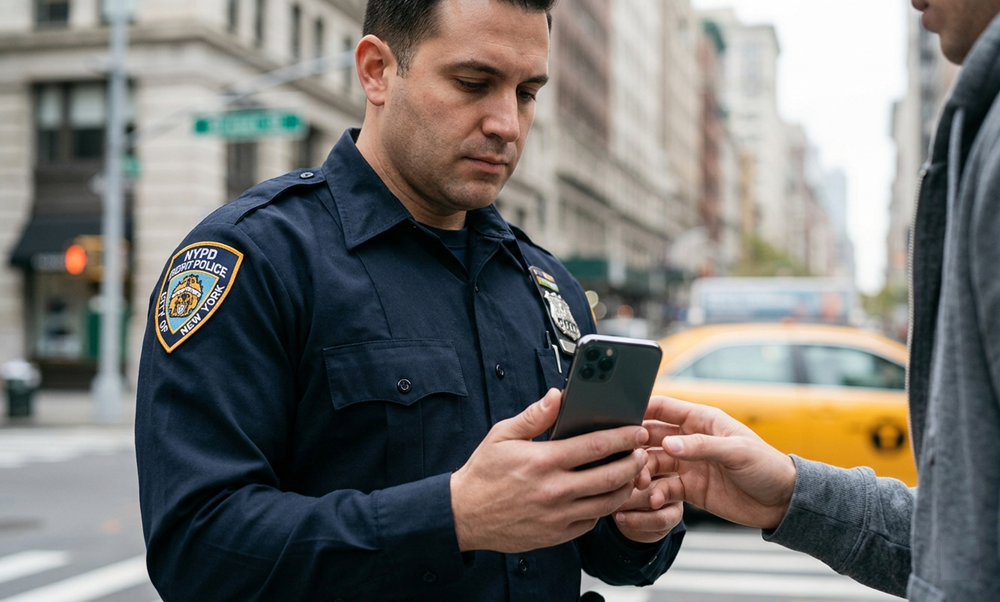
A police officer asks to look through your phone. You feel pressure to comply — but should you? Thanks to a landmark Supreme Court ruling and strong New York state protections, your smartphone is one of the most protected pieces of property you own. Here’s what the law actually says.
Can Police Search Your Phone Without a Warrant in New York?
No — in almost all circumstances, police cannot search your phone without a warrant in New York. This protection comes from both the U.S. Supreme Court (Riley v. California, 2014) and New York’s own strong privacy laws.
The Landmark Case: Riley v. California (2014)
In Riley v. California, the U.S. Supreme Court unanimously held that police must obtain a warrant before searching a cell phone seized during an arrest. The Court recognized that modern smartphones contain immense personal information — photos, emails, bank records, location history — equivalent to a “minicomputer” that deserves full Fourth Amendment protection.
When Can Police Search Your Phone Legally?
- With a valid search warrant signed by a judge
- If you voluntarily consent to the search
- In genuine emergencies where lives are at immediate risk (very narrow exception)
What Are Your Rights During a Police Phone Search Attempt in New York?
- You have the right to clearly and calmly refuse consent to search your phone
- You are not required to unlock your phone or provide your passcode
- You can state: “I do not consent to a search of my phone”
- Refusing to unlock your phone is not an admission of guilt
- If police search anyway, the evidence may be suppressed in court
New York’s Additional Protections
New York courts have taken an even more expansive view of digital privacy than the federal standard in some cases. New York’s Constitution provides independent privacy protections, and courts have been aggressive about suppressing evidence obtained from phone searches that lacked proper warrants.
| Scenario | Police Can Search? |
| Valid warrant obtained | Yes |
| You give voluntary consent | Yes — but you can refuse |
| Phone seized at arrest, no warrant | No — Riley v. California applies |
| Genuine emergency (e.g., bomb threat) | Possibly — very narrow exception |
| Phone found at a crime scene | No — warrant still required |
What If Police Search Your Phone Without a Warrant?
Don’t physically resist — that can result in additional charges. Instead, clearly state your objection: “I do not consent to this search.” Then tell your attorney immediately. Any evidence found during an unlawful search may be excluded from your case under the exclusionary rule.
Common Mistakes to Avoid
- Assuming cooperation means unlocking your phone — it doesn’t
- Consenting because you feel you have “nothing to hide” — your constitutional rights don’t depend on guilt
- Physically resisting a search — always refuse verbally, never physically
- Not telling your attorney if police searched your phone
FAQs
Can police force you to unlock your phone using your fingerprint or face ID?
This is still a developing area of law. Courts are divided on whether biometric unlocking (fingerprint/Face ID) is protected like a passcode. A PIN or password is generally considered more protected — switching to one adds a layer of legal protection.
What if I accidentally consent to a phone search?
Even accidental consent can be waived. However, if you can show the consent was coerced or you didn’t understand what you were agreeing to, your attorney may be able to challenge it.
Can police track my phone without a warrant in New York?
No — the Supreme Court’s ruling in Carpenter v. United States (2018) extended warrant requirements to cell-site location data, meaning police generally need a warrant to access your phone’s location history.
Your digital life deserves the same constitutional protection as your home. Know your rights, refuse clearly, and contact an attorney if police attempt to access your phone without a warrant.
Internal links: Your Fourth Amendment Rights During Police Stops | How to Handle Police Encounters in New York | What to Do If You’re Arrested in New York
External references: Riley v. California, 573 U.S. 373 (2014) | ACLU New York — Digital Rights