
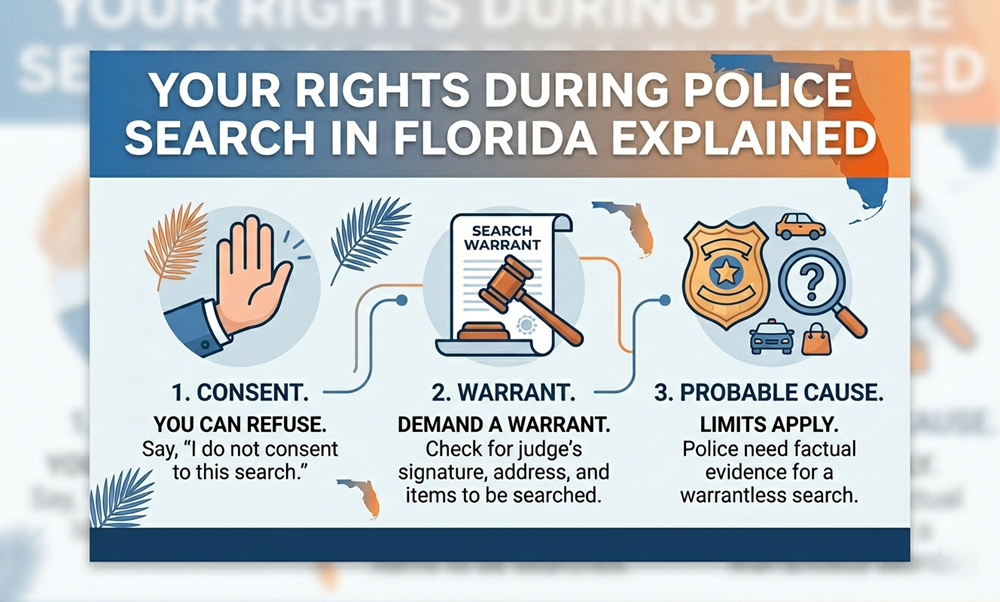
Being stopped by police in Florida is a situation where knowing your rights ahead of time makes all the difference. Whether it’s a traffic stop, a search of your home, or a pat-down on the street, you have constitutional rights that apply — and knowing them can protect you from an unlawful search and the legal trouble that follows.
The Fourth Amendment: Your Foundation
The Fourth Amendment of the U.S. Constitution protects you from unreasonable searches and seizures. Florida’s state constitution provides parallel protections. Together, they mean police cannot search you, your car, or your home without either your consent, a valid warrant, or specific legal exceptions.
Your Rights During a Police Search in Florida
1. The Right to Refuse Consent
You are not legally required to consent to a search. If a police officer asks to search your car or home, you can clearly say, “I do not consent to a search.” This refusal cannot legally be used as evidence of guilt, and it preserves your ability to challenge any evidence found if police search anyway.
2. The Right Against Unlawful Stop and Frisk
Florida follows Terry v. Ohio: police can briefly detain and pat-down someone only if they have reasonable articulable suspicion of criminal activity. A hunch or your appearance alone is not enough. If police overstep, any evidence found may be suppressed.
3. Your Home Requires a Warrant
Police generally cannot enter your home without a warrant signed by a judge. Exceptions include: pursuing a fleeing felon, preventing destruction of evidence, or responding to an emergency. Even then, the exception is narrowly applied.
4. Your Car Has Fewer Protections
Vehicles have lower Fourth Amendment protection than homes. Police can search your car if they have probable cause — for example, if they smell marijuana, see contraband in plain view, or you consent. This is where many Floridians unknowingly waive their rights.
| Location | Level of Protection |
| Your home | Highest — warrant almost always required |
| Your car | Lower — probable cause or consent can authorize search |
| Your phone | High — Riley v. California requires warrant |
| Your person (pat-down) | Reasonable suspicion required for Terry stop |
| Open areas/plain view | No protection — anything visible can be seized |
What to Do During a Police Search in Florida
- Stay calm and don’t physically resist, even if the search is unlawful
- Clearly state “I do not consent to this search” — then stop talking
- Ask if you are free to leave — if yes, calmly walk away
- Don’t answer questions about where you’ve been or what you’ve been doing without an attorney
- As soon as possible, write down everything that happened — officer names, badge numbers, time, location
Common Mistakes Florida Residents Make
- Saying “I don’t have anything to hide” and consenting — this waives your rights
- Physically interfering with a search — always challenge it in court, not on the street
- Not invoking your right to an attorney when questioned
- Forgetting that everything you say can be used against you
Expert Insight: When Evidence Can Be Suppressed
If police violate your Fourth Amendment rights in Florida, your attorney can file a motion to suppress the unlawfully obtained evidence. If granted, that evidence is excluded from trial — and many cases collapse without it. This is why clearly refusing consent and noting every detail matters so much.
FAQs
Can police search my car in Florida without a warrant?
Yes, if they have probable cause — such as the smell of marijuana, seeing contraband, or you consenting. Without probable cause or consent, any search is unlawful.
Do I have to show ID to police in Florida?
Florida is a “stop and identify” state. If police have reasonable suspicion you’ve committed a crime, you must provide your name and address. However, you generally don’t have to show ID during a consensual encounter.
What happens if police search my home without a warrant in Florida?
Any evidence found during an unlawful warrantless search is typically inadmissible in court under the exclusionary rule. Contact a criminal defense attorney immediately.
- Internal links: What to Do If You’re Arrested in Florida | Florida Criminal Defense Rights | How to File a Police Misconduct Complaint in Florida
External references: Florida Constitution Article I, Section 12 | ACLU Florida — Know Your Rights